
Academic Admission Profile
Intellectual rigor, mathematical curiosity, and an analytical vocation to model risk and uncertainty in modern society. Discover the foundational skills and qualities that define successful actuarial candidates.
Applicant Qualities & Competencies
The program seeks applicants with balanced competencies across mathematics, economic awareness, and ethical commitment.
Logical & Abstract Reasoning
Ability to structure rigorous arguments, identify numeric patterns, and deduce sound conclusions from formal axiomatic premises.
Fundamental for coursework in Linear Algebra, Analytic Geometry, and the axiomatic formalization of probability theory.
Affinity for Mathematics & Data
A genuine intellectual passion for exploring mathematical structures, statistical analytics, and quantitative problem-solving.
A strong mathematical vocation sustains deep engagement throughout the ten semesters of demanding professional study.
Numerical & Algebraic Fluency
Operational dexterity with numbers, ratios, interest rates, proportions, and foundational algebraic operations.
Facilitates a seamless transition into single and multivariable differential and integral calculus, as well as financial mathematics.
Solid High School Foundations
Command of core high school topics: algebra, trigonometry, analytic geometry, and precalculus principles.
Serves as the foundation upon which first-year core coursework is constructed at the Academic Unit of Mathematics.
Interest in Finance, Economics & Risk
Analytical curiosity regarding financial markets, pension schemes, insurance instruments, and macroeconomic variables.
Grounds probabilistic and stochastic models in tangible real-world challenges affecting social welfare and the financial system.
Technological & Computational Affinity
Readiness to work with spreadsheets, numerical algorithms, statistical computing packages, and programming languages.
The contemporary actuary fuses mathematical rigor with computational power through tools such as Python, R, and SQL.
Technical English Reading Comprehension
Ability to read academic research, software documentation, and international actuarial certification materials.
A major portion of actuarial research, professional libraries, and global credentialing examinations is published in English.
Discipline, Perseverance & Focus
Consistent self-directed study habits, sustained focus, and resilience when tackling complex proofs and mathematical problems.
The intellectual rigor of actuarial science rewards students with structured methodology, grit, and analytical persistence.
Effective Oral & Written Communication
Ability to articulate quantitative insights and technical risk findings clearly to executive decision-makers and non-technical stakeholders.
An actuarial model yields strategic value only when the practitioner effectively communicates its assumptions and implications.
Ethics & Social Responsibility
An unwavering commitment to professional integrity, data transparency, and understanding the societal impact of financial models.
Actuaries safeguard the financial security of millions of individuals and institutions, requiring paramount technical and moral probity.
Recommended Prerequisite Topics
Applicants who review and master these fundamental concepts transition with high confidence into first-semester university mathematics:
Fundamental Algebra
- Polynomial operations and special products
- Factoring techniques and algebraic fraction simplification
- Linear and quadratic equations; 2x2 and 3x3 systems of equations
- Exponent rules, radicals, and properties of logarithms
- Basic matrix operations and determinants
Trigonometry & Analytic Geometry
- Right triangle trigonometric ratios and the unit circle
- Fundamental identities, law of sines, and law of cosines
- Line equations, distances between points, and slopes
- Conic sections in the Cartesian plane: circle, parabola, ellipse, and hyperbola
- Polar coordinate systems and elementary transformations
Precalculus & Functions
- Formal concept of function: domain, codomain, and range
- Graphs and behavior of polynomial, rational, and transcendental functions
- Intuitive notion of function limits and continuity
- Concept of instantaneous rate of change and introduction to derivatives
- Geometric interpretation of the tangent line
Elementary Statistics & Probability
- Data organization: frequency distributions and histograms
- Measures of central tendency: mean, median, and mode
- Measures of dispersion: variance, standard deviation, and interquartile range
- Counting techniques: multiplication rule, permutations, and combinations
- Classical probability and fundamental axioms of independent events
Applied Mathematical Modeling in the Program
During your actuarial degree, abstract mathematical formulations transform into powerful quantitative tools for modeling complex economic dynamics:
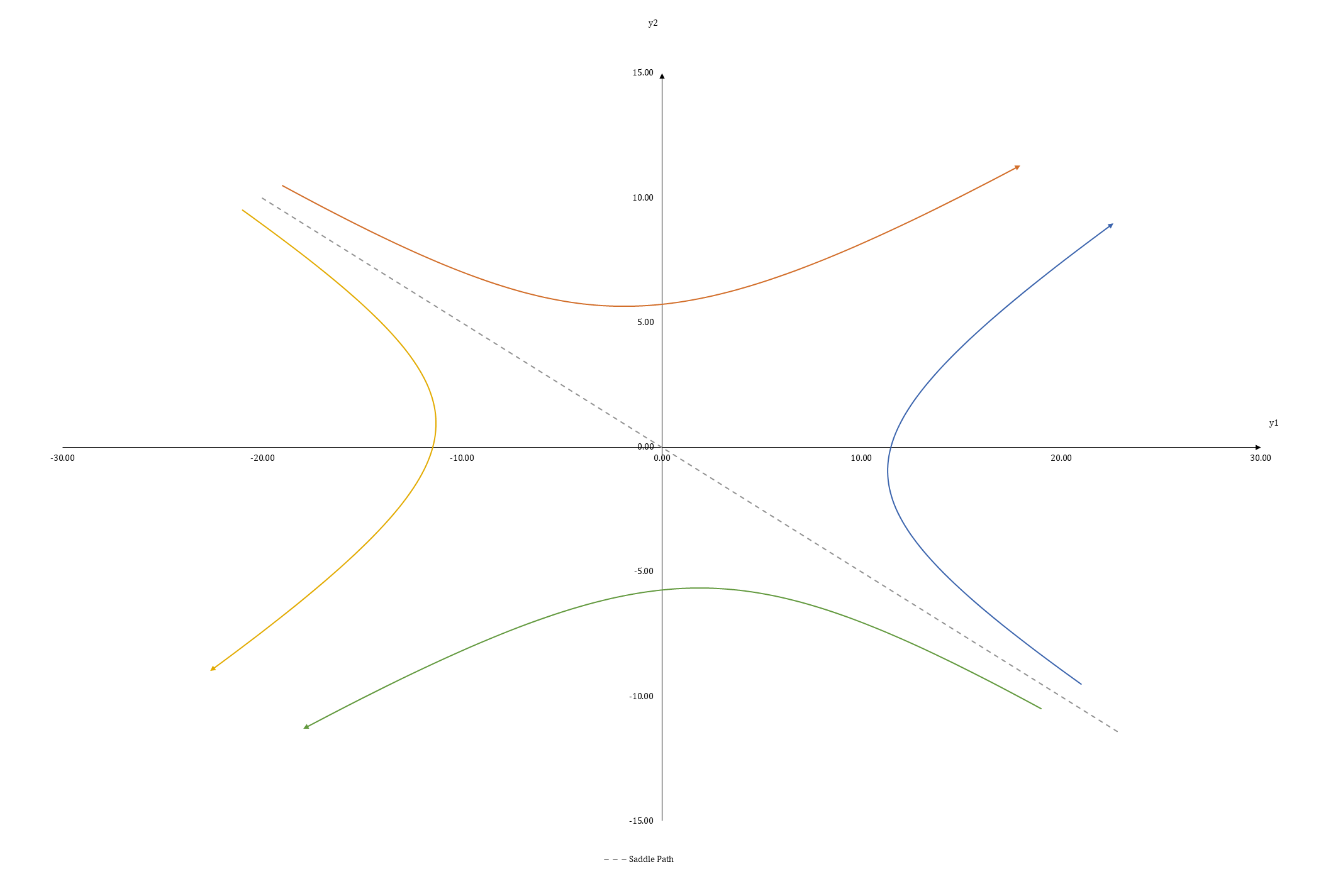 Quantitative Dynamics
Phase Diagrams & Dynamic Systems
In advanced coursework including Financial Mathematics and Economic Modeling, students solve dynamic differential systems to project intertemporal market equilibria and optimal investment trajectories.
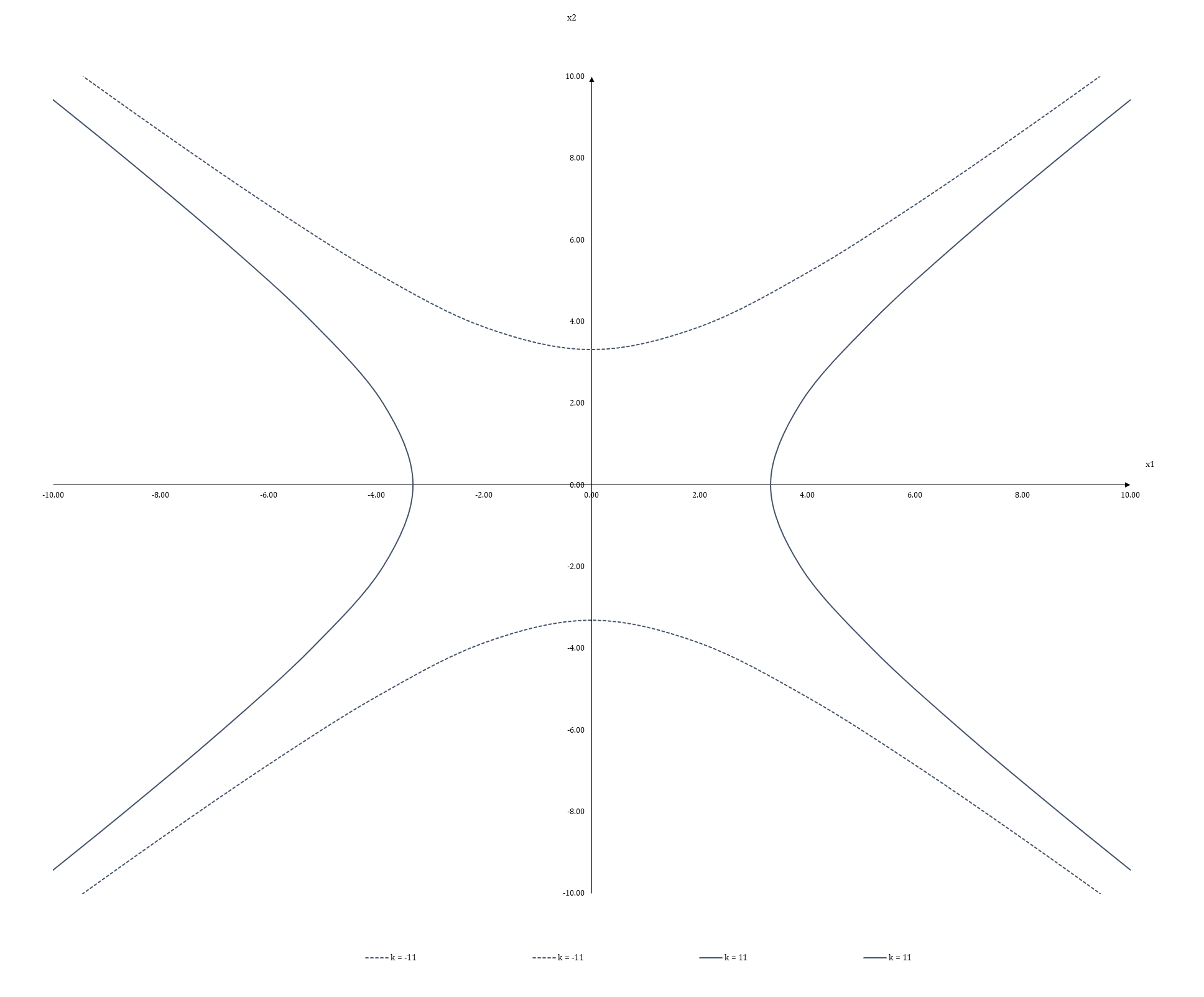 Operations Research
Multivariate Nonlinear Optimization
UAZ-trained actuaries analyze constrained optimization problems with equality and inequality restrictions (KKT conditions), modeling indifference surfaces, efficient portfolio frontiers, and solvency capital margins.
CENEVAL EXANI-II Admissions Examination
Official institutional evaluation administered by Mexico's National Center for Higher Education Evaluation (CENEVAL).
Mathematical Reasoning
Assesses quantitative problem-solving, algebraic modeling, and geometric visualization across two sub-areas:
- Mathematical Comprehension: Ratios, linear equations, graphs, symmetry, frequency distributions, exponent laws, and basic probability.
- Mathematization: Quadratic equations, systems of linear equations, trigonometric relationships, and dispersion measures.
Reading Comprehension
Measures rigorous textual analysis, thesis identification, and contextual interpretation across academic and public registers.
- Academic & Scientific Texts: Argumentative essays, technical research digests, and evidence-based analysis.
- Critical Reading: Discerning authorial premise, contextual inferences, and structural evaluation.
Indirect Writing & Grammar
Evaluates syntactic accuracy, semantic coherence, orthography, and normative precision in formal written Spanish.
- Grammar & Syntax: Subject-verb agreement, syntactic subordination, logical cohesion, and clarity.
- Orthographic Precision: Punctuation accuracy, diacritical marks, and standard academic conventions.
Ready to Begin Your Actuarial Journey?
Check the upcoming admissions schedule, examine the complete 10-semester curriculum plan, or review career pathways in our Graduate Profile.